Words: Adam Ketterer – Founder
Category(s): Content
Date: 18th August 2026
This past week, as news broke that Anthropic would start watermarking text generated by Claude, there was a great sucking sound heard across the B2B marketing world. It was the collective, sharp intake of breath from lazy content producers as they realised their beloved LLMs would soon be printing receipts to betray their masters’ sloppy copy habits.
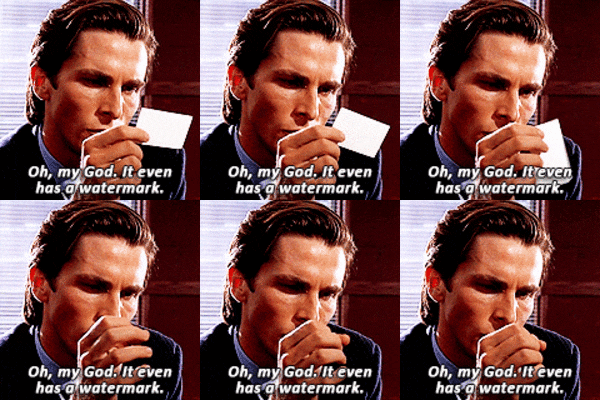
“Oh, my god. It even has a watermark.”
How the actual mechanics of this watermarking will work is not clear. Anthropic says, “Because the watermark is part of the text, it will travel with the text when it’s copied and pasted elsewhere, and may persist through some editing.”
Of course there are plenty of problems with a simplistic labeling of AI-generated or, euphemistically, AI-assisted content. (If you write an article and feed it to Claude to find typos, could you be shamed on a par with the worst of the LinkedIn slop farmers?)
And there will doubtless be workarounds and cheatcodes, as the industry plays cat and mouse with user sentiment, behaviour, ethics, and the various standards and regulations AI companies will be held to.
The watermark thing is definitely a step in the right direction. But surface tells [to use one of the LLMs’ favourite words] are not the real problem – something else is [to force a negative parallelism].
The problem runs deeper than a watermark
The tells and tropes of AI writing are obvious and cringeworthy to the extent that a watermark is hardly necessary most of the time.
So if your reaction to the watermarking news is unease about being found out for an over-dependence on GenAI, it’s probably too late for you anyway.
What B2B brands should really be worried about is what happens even if they’re not found out. It’s a result of this relentless pressure to optimize – or sloptimize – content production and marketing processes to the point where the resulting written content is not just the mean-average of everyone else’s style but also the mean-average of everyone else’s thinking.
It’s this: the total eradication of a distinctive point of view from your content.
And it’s happening right now in marketing departments – and entire companies – where content marketing is turning into a complex of automated AI workflows, generated text, and the outsourcing of thinking.
Slop has no point of view. How about you?
Slop is defined on Wikipedia as “digital content made with generative artificial intelligence that is perceived as lacking in effort, quality, or meaning” – to which I’d add that it is also lacking in a point of view.
You’ve experienced it yourself, reading something that you soon realise is AI-generated because it takes a long time to say basically nothing at all.
I think that’s because of the POV deficit. And if you’ve heard me bang on about POV before, you’ll know that I believe that a brand with no POV is not a brand after all.
Your POV is:
- your perspective on something important.
- how you see things from where you stand relative to others.
- your view on your world (of enterprise software, or precision-cut widgets, or whatever) – not on the whole world.
- what creates your TOV, which emerges from it.
- a point of view that you can persuade other people to adopt.
(If you’re interested, read more here: A brand is its point of view embodied by its actions.)
Your content can communicate your POV, but it also helps you to define and refine it. The process is the thing. (And the writers are the keepers of the sacred truth of your brand, in my opinion. [link to other post about writers.])
AI slop doesn’t have any of that. And even if you’d never consider comparing your own ‘AI-assisted’ processes to sloptimization, ask yourself if you’re truly confident you’re not eroding the POV in your content.
Don’t worry about being found out. Worry about getting away with it and sloptimizing your way to a well-tuned content machine with absolutely nothing worth saying.