Words: Luke Gain – Strategy Director
Category(s): Branding, Campaigns, Content
Date: 22nd July 2026
Creating a visual brand for a technical B2B offer is tough. There’s a lot to explain when products or services solve big, hairy, abstract problems with complex technologies and processes.
And that usually means the visual identity inherits some heavy lifting — obliged to illuminate or unpack in some way what the technology does, or how it works.
But when explaining your product becomes the gravitational center of your visual brand, you walk into one of B2B’s biggest traps that leads design teams down a visual cul-de-sac.
The moment you make your technology or product the hero in your visual story, your destination is inevitable. No matter what path you take, you end up in a world of Nodes and Connectors.
Nodes and connectors are versatile but ubiquitous
Nodes and connectors are base elements of B2B design. It’s hard to get away from them.
Technology products and services are made of components and the relationships between them. Any design that seeks to represent them needs a way to explain how discrete elements interact.
The trouble is that once you see them, they’re everywhere.
Check it out:

The HubSpot Sprocket – Hubspot probably wasn’t the first to use Nodes and Connectors as a major brand device. But their logo is probably the most famous example

The Google Drive icon – Probably the most distinctive application of Nodes and Connectors here – but it shares the same underlying DNA.
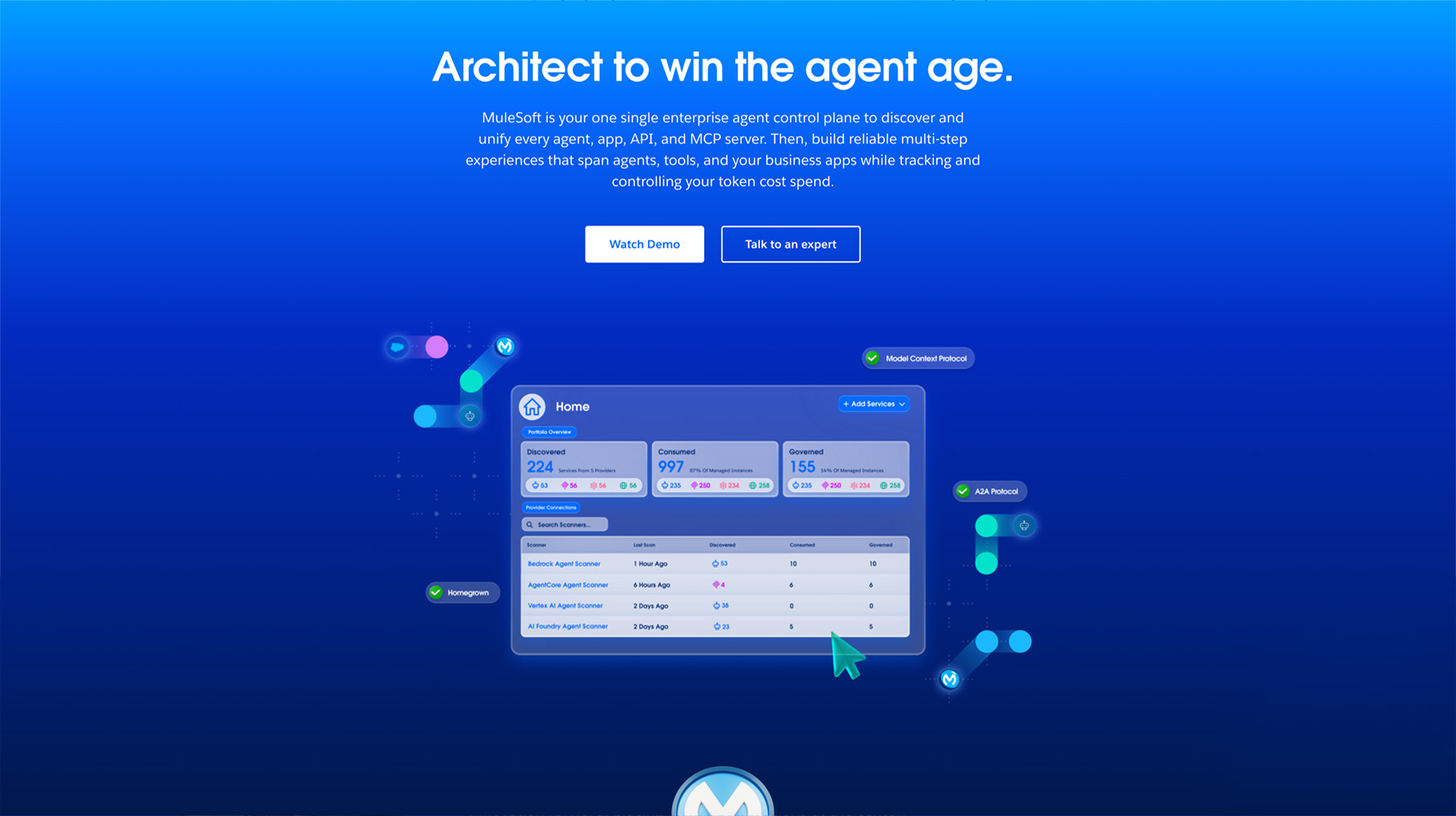
Mulesoft’s Hero Homepage Graphic – One of the most common applications – annotations around a product interface conveying multi-step workflows or processes.

Asana’s hero homepage graphic – Another multi-step workflow graphic where the nodes and connectors are the hero instead of the annotation.

n8n’s workflow diagram and feature descriptions – n8n use nodes and connectors as the primary visual system – to convey workflow diagrams and unrelated benefits/features.

SAP Industry image overlays – Photography overlay treatment to represent digital processes within a physical environment.

ServiceNow’s user relationships – An inversion of the overlay treatment that inserts physical users into the node and connector environment.

KPMG’s CTA – One of the most common tropes – an overlaid mesh of nodes and connectors often used to represent data and networks

Cisco’s “Why us?” pages – A stylized and futuristic 3D render of nodes and connectors to represent Cisco’s future vision

Accenture’s awards module – A decorative and abstract illustration.

Quantexa’s icon library – Nodes and connectors form elements of icons rather than as hero visual
Don’t jump into a pack by mistake
I didn’t have to look hard to assemble this list. But even this small selection demonstrates just how frequent and how varied the applications of nodes and connectors are in B2B, ranging from:
- The hero metaphor of the brand
- A diagram of how technologies integrate or processes flow
- The key framing device within a brand system
- A representation of digital technology across physical environments and users
- Decorative illustration
- Fundamental elements of iconography
This post isn’t about judging the relative merits of these applications (I’ll leave that to you).
It’s about highlighting the pack you jump into when nodes and connectors become a prominent part of your visual language.
I’m really sorry, we’re going to talk about Semiotics
Semiotics is the study of signs. Every sign has two parts – a signifier and a signified. (When I say “Dog”, you think of one.)
But overexposure to dots, lines and meshes as the fundamental visual grammar of B2B means your audience now brings their own associations to those signifiers.
To you, they represent specific details about the way you connect workflows, systems and data. To your buyers, it situates you in a big soup of samey B2B brands.
So before you’ve had a chance to explain why you’re different, your audience puts you into a pre-existing category packed with brands that look just like you. In trying to communicate something specific, you become part of the backdrop.
Your product is not a POV
Here’s the thing. Nodes and connectors aren’t the real problem here. They’re a byproduct of a sequencing issue between brand and product.
Strong B2B visual identities are built on ideas – ideas, metaphors or motifs that represent something essential to your POV and your offer.
Metaphors are incredibly powerful in B2B. They make complex topics simple, interesting, desirable and motivating. Adam’s post on “Illuminating Metaphors” describes them as “the ultimate hack for intuitive shorthand sensemaking that sticks in the mind”.
But the graphical language of product visualisation isn’t a metaphor, or even an idea – it’s descriptive and representational. The goal is to show users what it is they’re buying.
It’s important to do that. But if your product is the main character in your visual brand, you forfeit the opportunity for an analogy or metaphor that illuminates what you do in an unexpected and memorable way.
If you’re going through a B2B visual refresh right now, keep an eye out for nodes and connectors becoming too prominent in your design system.
I’m not saying you should ban them altogether. But use them purposefully and specifically. For product and workflow diagrams? Sure. But as the central hero of your visual system? That space hasn’t been white for a long time.