The B2B guide to quantum computing 

The B2B guide to quantum computing


How to position your brand when tech’s Next Big Thing changes everything (again)

A quantum leap for B2B tech

If quantum computing isn’t on your radar, it should be. Like AI, it’s been stealthily drawing closer for years. And, just as AI did, it’s set to arrive with the suddenness of a jump scare, shaking up entire industries.

So at Beneath, we thought it was about time someone put together a guide for everyone who’ll need to market this weird, wonderful, world-changing tech:

  • Suppliers to the fast-growing quantum computing industry
  • B2B tech companies selling quantum-enabled solutions
  • And quantum computing companies themselves

We’ll explore the opportunities that quantum computers are unlocking, industry by industry, and share our thoughts on how to position quantum solutions to your customers.

But first, we’ll give you a quick grounding in the technology itself. If you can already chat qubits over your pre-conference croissants, go ahead and skip to the practical advice.

01.
What is quantum computing?

The fastest way to understand a quantum computer? Stand it next to a classical computer, like the smartphone, laptop, or PC you’re using to read this guide.

A classical computer processes information in the form of bits. Any given bit, at any given time, can exist in either of two states: a one or a zero.

A quantum computer, however, processes “qubits”. Any given qubit, at any given time, can be a one, a zero, or it can be in “superposition”: neither of those states.

When a qubit is in superposition, it’s like a flipped coin spinning in midair. (No, you’re right – it’s not like that. But trust us, unless you’ve time to dive much deeper, the analogy’s helpful.) There’s some probability the qubit/coin will land on one/heads, and some probability it’ll land on zero/tails.

Now, imagine a labyrinth with one entrance and one exit. To find the quickest path through, a classical computer would have to explore each in turn by making a choice – heads or tails, one or zero – every time the path divides.

You can think of a quantum computer as placing a spinning qubit/coin at every junction of the maze. While the qubits are in this state, they can be carefully manipulated to increase the likelihood that, when they’re measured – when the coins land – the correct path is revealed.

Suffice to say, this opens some powerful computational doors. Questions that a classical supercomputer would need trillions years to chew over could, in theory, be answered by a quantum computer in a matter of days.

(If you do want to plunge deep into the technology’s fundamental principles, check out our quantum computing bookshelf at the end of this guide.)


From physicist’s dream to functioning machine

Like so many new tech trends, quantum computing has been knocking around for a very long time.

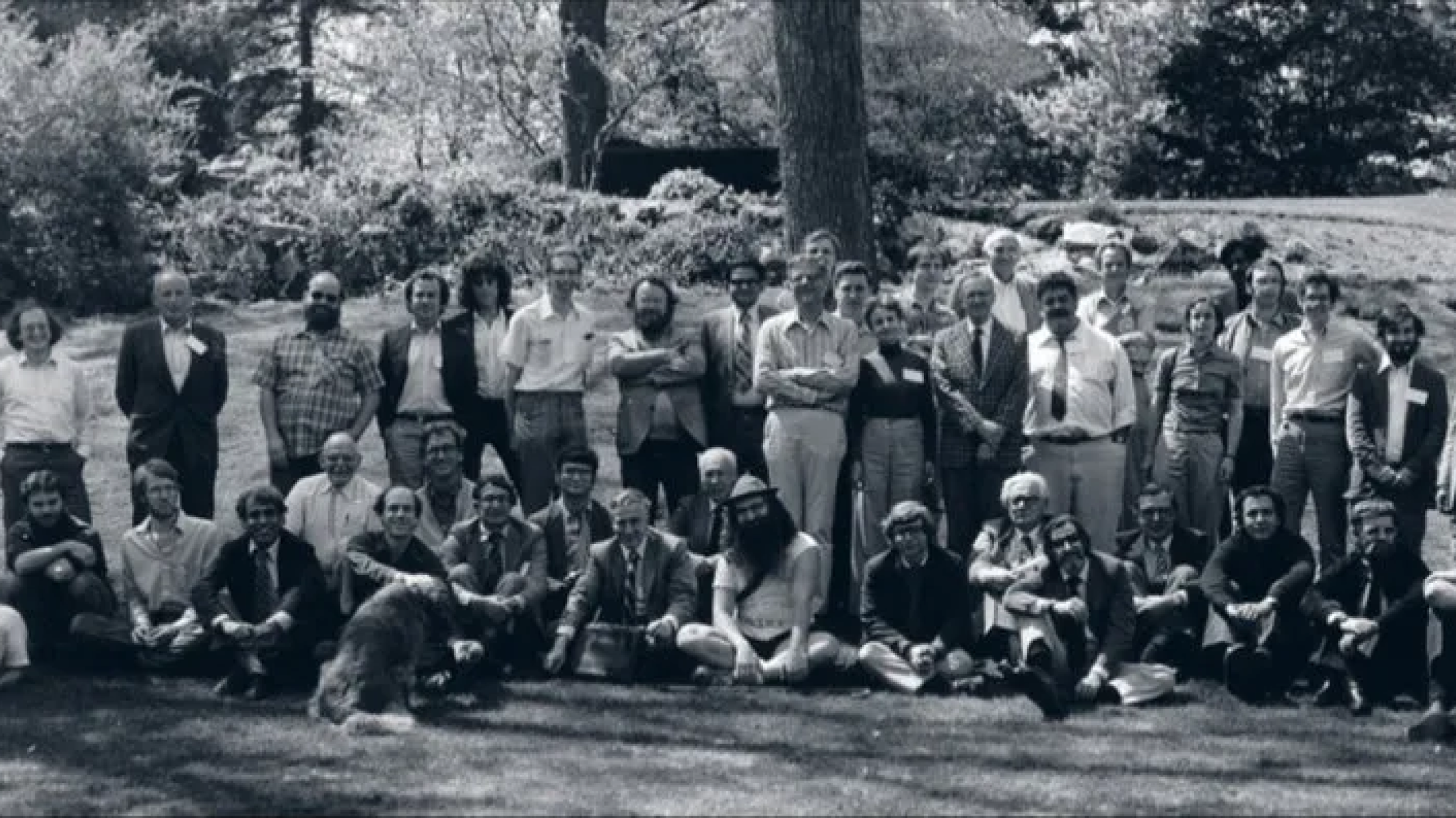
One of the people we have to thank is Richard Feynman, AKA the quantum physicist who said, “nobody understands quantum mechanics”. Presumably he didn’t include himself in that by 1981, when he joined fellow science and tech luminaries at an MIT conference (squad pic below) to do what science and tech luminaries do best: nerd it out over how to engineer dazzling technological breakthroughs.

Over three days, they thrashed out how to apply the principles of quantum physics to create the most efficient computers ever seen.

MIT and conference co-host IBM both became heavily invested in the field, but it was another tech titan that, almost forty years later, finally proved quantum computers could handle problems way beyond their classical counterparts.

In late 2019, Google announced its 54-qubit quantum computer had solved a test calculation that would have kept the next best supercomputer occupied for ten millennia. Google’s quantum computer had cracked it in all of 200 seconds.

The many, many barriers to quantum computing

Why was quantum’s gestation so painfully slow? The short answer is: building a quantum computer is incredibly hard.

Qubits lose the information they’re holding at the drop of a hat. Or anything else that causes a tiny vibration, or temperature change, or other fluctuation in the surrounding environment. As a result, quantum computers need to be kept very, very cold, and ideally, in a vacuum.

To make matters worse, even when you satisfy all their high-maintenance demands, a quantum computer will produce a lot of errors. You can mitigate this by adding many more qubits to the computer, but simply building and controlling qubits, at scale, is an immense technical challenge in itself.

02.
Why the quantum wave is about to break

The good news is, after decades of throwing brilliant minds and bricks of money at the sizable barriers to quantum computing, those barriers are finally springing some leaks.

We’re now seeing breakthroughs in quantum error correction, from companies like AWS, but also from quantum computing start-ups, like Alice & Bob. The latter has designed a [checks notes] “cat qubit” with built-in correction for a big chunk of common errors.

At the same time, both Google and IBM are rapidly upping the number of qubits in their processors. IBM recently unveiled Heron, its most performant processor to date, less than a year after passing the 1,000-qubit mark with its similarly groundbreaking Condor.

There’s even a glimmer of good news concerning quantum computers’ extravagant cooling needs. Recent developments in spin wave technology are bringing us closer to replacing the electron flows that produce so much heat as they transmit information. (This may also lead to smartphones that don’t gently warm your thigh.)

New coding languages are also being developed to harness quantum algorithms, although old staples like Python have proven themselves capable of being used in a quantum context.

How a B2B tech fan favourite has helped clear the way

Crucially, today, we’re also living on the right side of the cloud computing revolution.

Given the size and sensitive nature of quantum computers, and the cost of building and running them, few businesses will be keeping a quantum machine “on prem”.

But with a cloud model, that problem evaporates. Any organization can tap into as much quantum computing power as they need, whenever they need it. (That’s right – get ready to worry that you’re mispronouncing “QaaS”.)

Amazon, IBM, Google, and Microsoft are among the companies that have already launched commercial quantum-computing cloud services. Quantum computer operating systems like ParityOS will run in the cloud, too.

Who’s funding the race for quantum?

Private tech companies may be leading the charge, but governments worldwide are also heavily invested in quantum computing. The US, Russia, China – all have earmarked billions (in USD terms) to help advance the technology.

The UK, through its National Quantum Strategy, is aiming to equip itself with accessible quantum computers by 2035. And in Denmark, public and private spending commitments have helped the nation to lead the world on per capita investment in quantum technology, building on a scientific heritage that stretches right back to quantum theory pioneer Niels Bohr.

03.

How will quantum computers change our lives?

As you’ll have gathered, we won’t all be getting our own, personal quantum computer any time soon. But dry those eyes. Because even if you could sit one on your desk, or slip one into your pocket, you probably wouldn’t find it very useful.

There’s little benefit to using a quantum computer for the relatively straightforward processes involved in everyday web-browsing or graphic-rendering. The same goes for emailing, messaging and video-calling.

Classical computers can handle all these simpler tasks and calculations just fine. In some instances, a quantum computer might achieve a negligible increase in speed, but it’d be like slicing a loaf with a saw instead of a bread knife.

Enough about what they won’t do

While we aren’t about to start carrying quantum computers around with us, we will certainly feel their presence as we use our favourite devices.

Quantum computers will sit behind the scenes (i.e. in a data centre) processing massive amounts of data and solving complex computational problems. Thanks to their efforts, we’ll use more accurate, more predictive search engines, and arrive on webpages that respond and adapt to us in ways that go far beyond swapping the odd component in and out.

Quantum computers will also deliver a major upgrade to our favourite AI tools. Backed by their immense data-processing power, AI will be able to provide smarter, faster, more sophisticated responses to our queries. Indeed, Dr. Théau Peronnin, Alice & Bob’s cofounder, believes quantum computing could propel AIs towards the feted “human-level intelligence” they’ve so far failed to achieve.

Even when we put our phones, tablets, laptops and smart everything-elses away, quantum computing will continue to shape our days. It’ll shorten our commutes. Help with our personal finances. And maybe even save our lives.

That’s because quantum computing is huge news for any industry that crunches numbers using complex formulae, advanced algorithms, predictive analytics and modelling. Industries like logistics, financial services, and healthcare and pharma.

Download our bluffer’s guide to quantum computing

Was that way too much quantum information for your human brain to compute? Don’t worry – just grab a copy of our bluffer’s guide.

Download PDF

04.
Will your industry be transformed?

Let’s get down to business. In some industries, the application of quantum computing to existing challenges is already well underway.

  • Supply chain and logistics

  • With quantum computers in their tech stack, supply chain managers will be able to create more powerful models, and better predict, plan for, and respond to disruption – rapidly simulating different outcomes. They’ll also benefit from quantum’s incredible knack for identifying the most efficient solution to optimisation problems.

    Talking of efficiency, Ford has teamed up with NASA to work on fuel-efficient route planning for fleet managers; all the requisite pattern recognition and analysis is much more efficient with a quantum computer at the wheel. As you might imagine, this kind of quantum-enhanced routing promises to deliver benefits throughout the logistics industry, unlocking more consistent, accurate and predictable delivery ETAs.

  • Energy

  • There’s growing excitement about the potential to simulate battery chemistry, unlocking the development of cells with significantly higher energy density. This could be transformational for the energy industry, reducing the cost of grid-scale storage and making renewable options such as solar power more economically competitive.

  • Healthcare and pharma

  • Quantum computing promises to accelerate R&D across industries, providing the processing power needed to streamline processes, optimise prototypes, improve product safety, and reduce waste. In healthcare and pharma, where time to market can be a matter of life and death, the impact will be especially profound.

    Quantum computers can simulate chemical bonds, which makes them incredibly useful for inventing new materials and chemicals. Quantum sensing, meanwhile, which measures complex molecules and physical properties with greater accuracy, promises to upgrade not just drug discovery, but diagnostic techniques and medical imaging.

  • Martech and adtech

  • The martech and adtech industries, with their use of predictive analytics and pattern recognition, should really be popping the champagne.

    Quantum analytics and machine learning could turbocharge capabilities such as dynamic creative optimisation, seamlessly and rapidly constructing an ideal ad set for individuals, with supreme precision. True hyperpersonalization, here we come.

    Quantum algorithms could also strengthen campaign targeting, helping marketers to home in on prospects whose priorities align with a particular product’s USPs.

  • Telecommunications and CPaaS

  • Telecommunications companies are among the furthest on with quantum computing adoption. Use cases for telcos and CPaaS providers range from reducing network latency (and upping improving streaming and communication quality) to improving network routing and traffic management.

  • Financial services and fintech

  • Quantum computing can help financial services providers to step up portfolio analysis and risk management. Its advanced modelling and simulation capabilities were born for comparing market scenarios and complex financial instruments, developing financial trading strategies, and recommending the right investments.

    The technology’s data-processing power can also be used to support intelligent fraud detection and enhanced data protection.

  • Cybersecurity

  • There’s one famous drawback to the rise of quantum computing: it’s going to render our most popular method of data encryption useless. The quantum algorithm needed to crack the cryptography that currently protects our transactions and sensitive data already exists. All tomorrow’s hackers need is a computer capable of running it.

    The race is on to find a new way to keep our data safe, and quantum technology itself may hold the answer. Quantum key distribution has already been hailed by the likes of Toshiba as the heir to conventional cryptography.

05.
How to position your quantum offering

Whether you’re a bona fide quantum computing company, swim in the quantum computing ecosystem, or are plugging quantum computing power into your solutions, it’s time to consider how you’ll position the technology. Here’s our humble (but expert) advice.

The reassuring thing about positioning your brand through even the wildest tech hype cycles is that, amid all the change – indeed, precisely because of all those head-spinning predictions, false-starts, red herrings and legitimate developments – the best plan of action is to stick to the unchanging fundamentals of positioning.

First, define the elements of your positioning

When we help B2B tech companies with their positioning at Beneath, we distil the inputs down into six foundational questions. Depending on the nature of your quantum offering, your answers to some of these questions may be more important than others.

  • 1. Why must your story be told now?

  • Capture a moment of significant change or a challenging state of affairs in your customers’ world. This demand trigger is the relevant backdrop to your story.

    If you’re selling quantum microchips or some other piece of the quantum infrastructure puzzle, then you might want to focus on the paradigm shift that the new technology represents, and the timeliness of your offering in enabling it.

  • 2. What market category do you want to be in?

  • In other words, what type or product or service are you offering? Note the use of ‘want to’ here: on some (quite rare) occasions it might make sense to create a category. Or you might simply need to reframe the context in which people think about your offering.

    For pureplay quantum companies, applied quantum computing itself is a new mega-category, with plenty of corners to compete over. And there are still breakthroughs in infrastructure like quantum networks waiting to happen by the category leaders of the future. But a quantum-powered CRM? Ask yourself if being an AI-powered CRM sounds like a differentiator today before you go all-in on trying to own or create a category where commoditisation is surely on the way.

  • 3. What defines your ideal customer?

  • Identify who needs to hear this story, and who doesn’t. (The worst positionings try to be all things to all people.) And we don’t just mean standard personas that give you someone’s job title and what they had for breakfast. Identify the relevant traits that make these people the sole focus of your attention.

    On the one hand, quantum promises to benefit all of us –eventually. But your positioning is about the credible value you offer right now, and that will likely be for a much smaller subset of businesses and the people within them who have the kind of problems your quantum offering can help them solve. Identify and understand these few, important prospect types like your business depends on them – because it does.

  • 4. What do you help them achieve?

  • What is it that makes you the hero? Showcase the value, benefit or outcome that you ultimately give them. It also helps to show the peril of the status quo, to add danger and urgency. This can help you establish the villain of the piece.

    It may be that you’re positioning yourself against other players in your particular corner of the quantum world, or you might be talking more broadly about the benefits of a quantum approach compared with a traditional approach that employs classical computing.

  • 5. What are your competitive alternatives?

  • What are your potential customers using instead? Bear in mind that these might be recognised competitors, some kind of homegrown solution, an old way of doing things… or nothing. This is what you need to de-position.

    It may be that you’re positioning yourself against other players in your particular corner of the quantum world, or you might be talking more broadly about the benefits of a quantum approach compared with a traditional approach that employs classical computing.

  • 6. What makes you better than the alternatives?

  • What value or USP do you offer that none of these alternatives can, and that the people out there sorely need? This is the magic you bring to the party.

    We’ve listed this question last but it’s usually the most important element in your positioning equation, as it gives you a strong starting point (your differentiated value). Once you’ve got that, you can figure out who to target with a proposition that really lets your competitive edge shine.

What should a B2B brand narrative look like?

A B2B brand narrative should be digestible and memorable for company stakeholders, but have enough detail to make sense. Between 150 and 400 words is a good range to shoot for. It’s not necessarily a customer-facing message. But often brand narratives can be used as a company manifesto, appearing on website About pages.

The brand narrative’s ultimate (and probably most important) expression is the headline or tagline that distils your message down to a concise phrase and prioritises clarity over cleverness (but a mixture of both is always nice).

Sometimes you might have two or several taglines (for example, one that articulates a change-in-the-world story, and one that describes the product in more straightforward terms. Again these can be customer-facing or not. Taglines don’t have to appear on website homepages, but often they are the perfect H1 headline.

If only there was a team that could help…

Beneath helps B2B tech brands to tell the right story, whatever the market, whatever the technology – the trickier the better. We’ll help you quickly nail your quantum computing positioning, and lend a strategic hand throughout your quantum journey.

Have a browse of our website if you want to find out more. Or, hey, get in touch – having just written all this, we’re more than ready to stop and chat.

06.
The quantum computing bookshelf

Long read, The Financial Times

Quantum computing could break the Internet. This is how

This interactive article from The Financial Times may be a couple of years o…

This interactive article from The Financial Times may be a couple of years old, but it’s s…

Read
Book, Chris Ferrie

What You Shouldn’t Know About Quantum Computers

Oh, you do want to get into the maths? Ferrie’s free-to-download book provid…

Oh, you do want to get into the maths? Ferrie’s free-to-download book provides a more tech…

Read
Whitepaper (and Audiobook), Alice & Bob

Think Inside The Box

Want to grasp the finer points of quantum error correction? The cat-qubit cr…

Want to grasp the finer points of quantum error correction? The cat-qubit creators have yo…

Read
Long read, Fast Company

IBM built the biggest, coolest quantum computer. Now comes the hard part

Alex Pasternack’s article pulls back the curtain on IBM’s recent efforts to…

Alex Pasternack’s article pulls back the curtain on IBM’s recent efforts to advance quantu…

Read
Yearly report, McKinsey Digital

Quantum Technology Monitor

Every year, McKinsey rounds up developments in the quantum technology space,…

Every year, McKinsey rounds up developments in the quantum technology space, covering inve…

Read
Online learning resources, QuTech

The School of Quantum

Qutech is a quantum computing research institute based in the Netherlands. I…

Qutech is a quantum computing research institute based in the Netherlands. If you get bitt…

Read
Technology roadmap, IBM

IBM Technology Atlas: Quantum roadmap

IBM regularly updates its own quantum computing roadmap. You don’t need to g…

IBM regularly updates its own quantum computing roadmap. You don’t need to get the product…

Read
Privacy Overview

This website uses cookies so that we can provide you with the best user experience possible. Cookie information is stored in your browser and performs functions such as recognising you when you return to our website and helping our team to understand which sections of the website you find most interesting and useful.