A writer’s journey at Salesforce, true customer stories, and generally giving a sh*t
Words: Adam Ketterer – Founder
Date: 1st November 2024
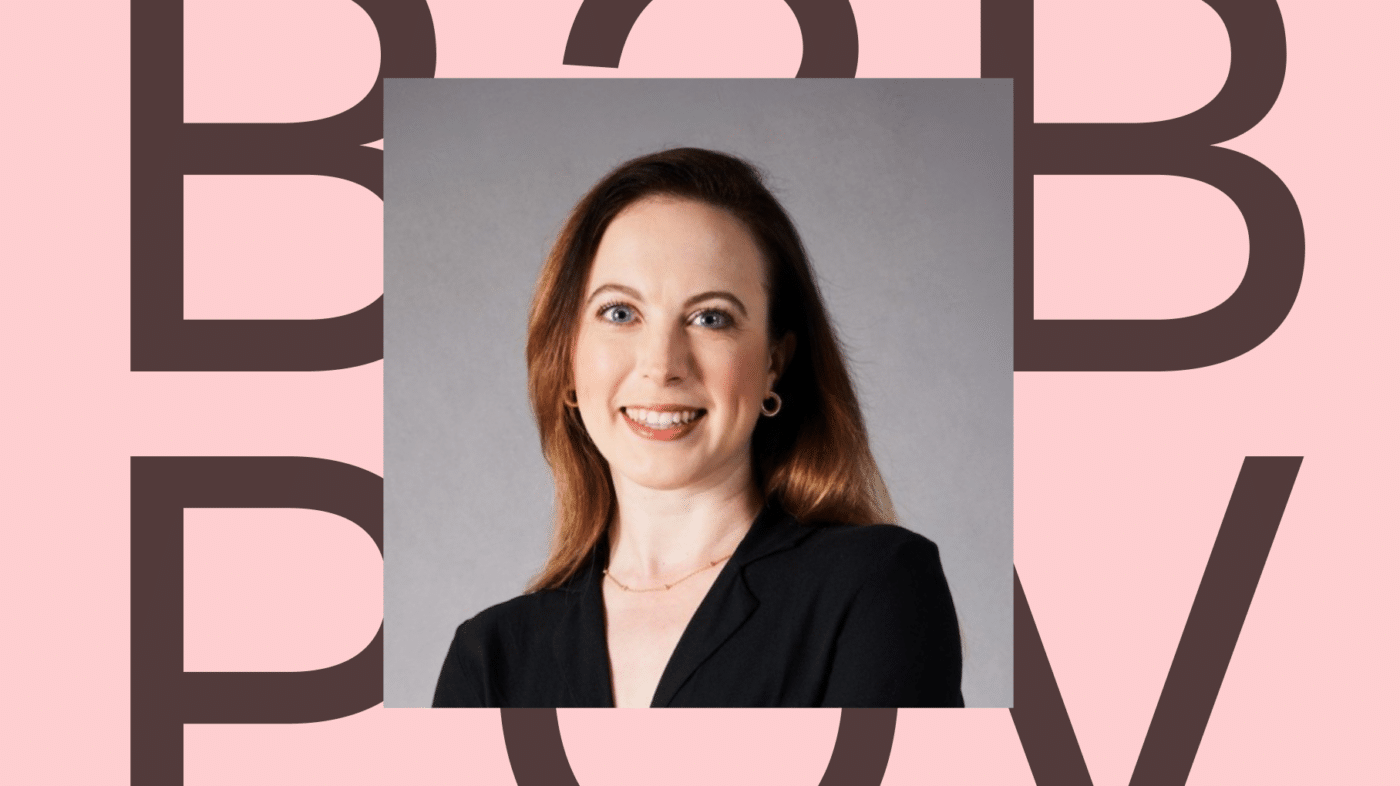
This time on B2B POV, we chat with Jess Crandon. Jess works at Salesforce where her job title is (at time of interview) ‘Senior Specialist, Content & Customer Marketing – EMEA Growth Markets’. But she remains, at heart, a writer.
We caught up about the complexities of articulating a focused point of view at such a large company, the need to balance brand impulses and customer trust, and the principles that keep a copywriter turning up and giving a sh*t when their job becomes so much more than writing.
The Q&A below is a written-up version of a Zoom conversation, edited slightly for brevity. Here are some highlights you can skip to:
- POV and messaging complexity at mega-corporations
- Finding focus in field marketing
- Getting work approved: seek permission or forgiveness?
- Writing great customer stories, without feeding them lines
- The subtle art of actually giving a sh*t
- The state of copywriting today: lazy
- The B2B copywriter’s dilemma: stand out or be invisible?
- Principles to write by
- A writer’s career path: from creator to producer
- Bringing the product back into content marketing
- Positioning Jess: be creative, build a network, say no, get it done
POV and messaging complexity at mega-corporations
Adam Ketterer: So everyone knows Salesforce. And of course it’s easy to get nostalgic about the early days of the “End of software!” message. But I’m curious about how you maintain a clear positioning and point of view at a company that grows as huge and complex as Salesforce has over time?
Jess Crandon: So have a single positioning line and messaging hierarchy. But yeah, you have to avoid the temptation of trying to be everything to everyone – especially when you kind of have become everything to everyone. You know, we serve a bunch of different industries across a load of different products. When that happens, there’s a risk the top-line stuff becomes so vague as to almost be worthless. You end up back with something that says we help companies do good stuff for customers!
So how do you turn it into something more helpful? If you lose detail, you lose authenticity. If you add too much detail, you end up with seven pages when you need just a few lines. It gets fragmented so quickly. You know, my Twitter feed is full of people asking, what does Salesforce actually do? And it’s so hard to answer because you’re like, well, yeah, we kind of do everything at this point. Which is obviously a terrible answer. So you need that single golden thread all the way through.
Finding focus in field marketing
I think for me it’s easier because I work in field marketing so I can kind of take our core messaging and make it relevant to each of our markets. So in this or that industry we might prioritise a certain cloud or a certain product and I can get more specific.
But yeah, it’s really hard and it definitely feels like it’s getting harder.
AK: Yeah it sounds tough. When a huge company really does do a lot of cool stuff for a lot of different people, the high-level messaging often loses its edge and the good stuff skips down a few levels, right? Into the specifics that you mention.
JC: Yeah. And we’re kind of lucky in region, because we don’t always have the budget for high-level awareness and brand campaigns. So a lot of what we do has to be more detail-led, and has to be much further down the funnel. It does mean that you can actually start proving what you are and who you are and what you’re doing… It’s hard because you can’t say something that’s gonna alienate your IT and dev audience. But, equally, what lands with them is likely not gonna land with the CFO audience or COO audience. And then that’s not gonna land with, like the Trailblazers and the people who are hands-on and Salesforce Admins. And THAT’S not gonna land with your CMO and your heads of marketing…
So yeah! I don’t envy our brand team there. It’s just one of those things. It’s a heavily matrixed organisation – which I find really fun to work in, because it is just that constant Tetris game of what means what to who? And how high can you elevate that message without losing it? At the same time it comes with a lot of challenges – how do you say something that doesn’t just sound like a sweeping generalisation?
Getting work approved: seek permission or forgiveness?
AK: Yeah and then you’ve got the big bold, fun stuff coming around like I remember seeing the Matthew McConaughey stuff. And the Bad Guy AI cowboy ad. That was a very random but kinda cool celebrity endorsement, I guess. And then there’s the kind of hard-working, everyday stuff. What’s the production process like at such a big org? How far up the chain do approvals go?
JC: Ha, well it’s a balancing act with approvals isn’t it? I’ve worked in smaller teams in fact-paced places where you generally ask for forgiveness, not permission. And this is where I think bigger companies struggle, when the reviews sometimes go too high. You want control, of course, but you also need trust. There are times when one customer story will have 20 reviewers going all the way up. And it can be slow and difficult, because what marketing wants to say isn’t necessarily what the customer is saying – and product messaging changes so fast. So we had one project – we were filming customers in the UAE and South Africa, and on the day, we were sat in hair and make-up with our customers and had to say, ‘please don’t call it X, please say Y, because we literally renamed this yesterday’. So you have to be careful to make sure the customer still feels confident speaking about their experience, and trusts what you’re doing.
Writing great customer stories, without feeding them lines
AK: God, that’s tough when you’ve got the feeling of trust potentially eroding on both sides. And that’s so interesting when you’ve got to agree on an approved story, but in a huge company you’ve got the brand messaging way over here, and then what the customer actually thinks and says way over here…where do you meet in the middle? Feels like at smaller companies the feedback loop is much smaller.
JC: Yeah that’s a good way of putting it. When I was starting at Salesforce – and even before, working on the agency side – the customers very much told their stories, and we had to capture it and make sure it was correct from a product messaging perspective, and so on. But essentially customers would just say what they did with the product. What I’ll always fight against is putting lines in our customers’ mouths. That goes against everything I stand for because then the customer isn’t telling their story. Then you’re just writing it and getting them to sign it off.
AK: Yeah that’s so true. I’ve definitely heard an exasperated writer say, why did we bother interviewing the customer if the client’s just going to rewrite it themselves?! And in fact in an interview recently I asked a customer about their use of a certain product name, and the customer account handler chimed in and said to them, oh that’s just marketing for XYZ, and used the language the customer is actually familiar with.
JC: Exactly, it gets too marketing-ified and you lose the story. You end up going from something that’s genuinely helpful to something that could have just been pushed out by a content marketing team. And what I’ve really enjoyed in this role is finding ways of teasing out those great lines and insights from the customer – without putting words in their mouths. Without over-editing what they’re saying.
AK: It’s like the fine art of leading the witness, a little bit – but not too much. Interviewing is such a skill. [Look out for our upcoming B2B POV with customer research and interviewing expert Hannah Shamji.] And it’s such a huge part of the job as a marketer and especially as a writer. I remember in my first ever office job, I was petrified to pick up the phone and call people – and these were people who actively wanted to be called. Just pure fear and anxiety and awkwardness. And after that I kind of accidentally ended up in a B2B PR job, so I had to pitch journalists – sometimes national journalists, who are not all very patient or nice – with utter sh*t stories. But over years of input call exposure therapy, I’ve grown to love doing them. It’s definitely a muscle you can train. I imagine you’re a good interviewer. You learn some tricks along the way anyway, right?
The subtle art of actually giving a sh*t
JC: Yeah I think my biggest thing is – having been on the interviewer side, to then being the client on a call with somebody else doing the interviewing – it’s so obvious when somebody just doesn’t care. You can tell when somebody has turned up to do the interview and they have maybe read the questions that we’ve agreed on, and that’s it. Maybe they’ve Googled a bit. All very surface level. And I think that if you are an older or more experienced interviewer you can get away with that – because you have those tricks, right? But if you’re on the more junior side or maybe you’re just not as good as blagging, it just makes me cringe. And hey, I was terrible when I started out! My interviews were probably the most painful things in the world.
And actually it reminds me of something Harry [Harendra Kapur, former head of writing at Velocity Partners] used to say, which was: I don’t care if your draft is bad, as long as I can tell that you’ve given a sh*t. Enthusiasm, I think, makes up like 80% of whether something ends up good or not. And I apply that now in my work when I’m reviewing something or in an interview. I think the interviewee can tell the difference between someone reading off a sheet of paper and someone who’s having a conversation and is actually interested in what they’re saying.
The state of copywriting today: lazy
AK: It reminds me of what you said earlier when we were chatting about the state of copywriting – and the lazy writing you’re seeing. And lazy interviewing is one symptom of that – a symptom and a cause, I guess. What’s your experience with lazy copywriting – what’s your rant?!
JC: Ha, I just feel it’s got so prevalent in the last year or two, I get such lazy writing sent through – I was reviewing something last week, and it was like, this person hasn’t even read the source material. They’re writing this off the title and maybe they’ve glanced at the introduction, or skimmed the subheads. But they haven’t read it. So not only is it factually inaccurate, I can tell you haven’t tried.
And I think that, as a writer, when you start out you’re very enthusiastic, trying to prove yourself and learn, so you do file stuff that is a bit inaccurate, too wordy, whatever – but you can neaten it up and you get better. But with the peaks and troughs of a writing career, you get to a point where you’ve learned so many shortcuts and ways of signposting – and being lazy, ultimately! And I think every writer pulls on them. And recently I had ten pages to review and I think I counted “unleash the power of X” like twelve or fifteen times, and I thought if I read this one more time I’m gonna stick pins in my eyes.
And I get it, tech isn’t interesting to everybody, but if you’re not interested in tech, find another job or find that point at which you are interested in a thing. If you’re not interested while you’re writing it, your audience sure as hell won’t be interested while they’re reading it.
The B2B copywriter’s dilemma: stand out or be invisible?
AK: Yeah I totally recognise the thing of developing hacks and stock phrases. You see people’s signature styles, and it feels a bit like forensics – oh that person who used to work for this agency, I can tell they’re still trying to sound like the old house style. But it’s so easy to slip into!
JC: And as a writer when you’re starting out, you might join an agency because you like the style but yeah, then how do you, as a writer, develop your own tone of voice and your own style when clients come to the agency because they want their stuff to sound like the agency’s voice? How do you develop yourself without pissing off the clients?
AK: Plus you’re kinda meant to be invisible as a copywriter, or to shapeshift at least. So as a B2B writer, is it good to develop an identifiable personal style? Or if I read something and think, oh Jess wrote that – is that actually bad?
JC: For me it comes down to…how do you form the principles that let you decide how you choose to include or not include, how you phrase something. Because if you’re constantly second-guessing – like how would so-and-so do this? – then you’re never going to develop. When you’re starting out, sure. But that can take away from building your own style or tone of voice – or just confidence! How do you as a writer develop that instinct that says this is the story I want to tell and how I want to tell it.
You can learn a lot from trying to write in someone else’s tone. At Salesforce, we don’t have a very obvious tone of voice. I think my favourite way of describing it, or seeing it described, is it’s like a more experienced colleague telling you the answer to something you’ve asked. And that’s something most people can run with. Not too formal, but an air of authority. Not too technical or in the weeds until you need to be. Then you see some brands that are very voicey, and it gets a lot.
AK: And you talk about principles – maybe writing or content marketing principles – but do you have a few that you always come back to.
Principles to write by
JC: I guess I come back to: Who is this for? Do they care – or why should they care? And related to the first, who is at the heart of this? With big brands you can fall into the trap of making yourself the hero. You see keynotes by companies that say they’re customer-centric and you’re like, but the hero if this story is… you.
AK: Right, and again I guess that’s just harder at the bigger companies where you don’t have a uniform customer. You have to trust the nodes in your network to adapt your messaging or whatever. I suppose you need ultra-governance or…trust.
JC: And I think the nice thing about places like Salesforce is that our brand and marketing teams aren’t afraid to change stuff up and keep pace with the tech. They’re not stuck in, ‘well we’ve always done it this way’ mode. So every six months, things change – and that can be great and it can be hard, and you have to pick your battles.
AK: Ha, nice. Have you had small victories where you have stood your ground and imposed your point of view?
JC: Yeah and I think that comes back to trust again. I’ve got a leadership team on the sales and the marketing sides that trust me, so if I make a decision, you know, I’ve proven over a couple of years that I can use the data or use those principles I mentioned to make good calls.
A writer’s career path: from creator to producer
And it’s funny saying that because – how do I say this in a nice way? – I think at first when you’re a copywriter you sometimes think marketing managers don’t know anything. And when you move into marketing it’s easy to fall into the trap of thinking oh salespeople don’t know anything. I’m very lucky in the regions I work in – we have phenomenal sales leaders and we have close relationships with them. I’d say my numbers align more closely to sales than they do to other parts of field marketing.
AK: I think you need a bit of that naivety and preciousness when you’re a young copywriter – and I definitely had it. But then you look back and realise, oh you sweet summer child. And that path from a writer to a writer-plus-whatever-else helps you see the bigger picture.
JC: I think that’s been one of the hardest parts of moving into this sort of role, is that I couldn’t actually tell you what my role is exactly any more. You do kind of go from being the creator to being the producer. On one hand it’s nice to be able to say I’ve got the bigger picture and I know what sales need, and I can set parameters for others to work within. But having tighter boundaries does put an onus on a writer to do a better job. And you either love it or hate it as a writer. It’s daunting but it’s also freeing.
So you find yourself thinking, as a marketer or content marketer I’d love to do some brand awareness stuff, but as a field marketer maybe I’ll do some webinars and actually drive some higher-value leads. You start asking what’s going to impact sales the most? And as a copywriter who stopped doing maths aged fifteen or sixteen, it does mean you have to start doing the numbers again! I kind of hate it, but I love it at the same time, seeing how impactful our work has been. Also just knowing more, being able to give better briefs. Some of the ones I used to get in old agencies were like, written on a post-it note and stuck on my desk.
AK: ‘Give me the freedom of a tight brief’ and all that.
Bringing the product back into content marketing
JC: One of our marketing leaders has a product background and he’s like, this is fluff, this is marketing aimed at marketers. And I agree! So we’re getting more technical, more specific – you know if we say we can improve your customer experience, it’s like okay what does that mean? Does it mean they don’t have to wait on hold for customer service for long? What’s the exact use case?
Which, again, helps us answer the question of what is Salesforce? You can tailor the answer to the situation – and you can make it about the product, when it’s appropriate, because it does have to be about the product.
AK: Yeah I remember a couple of years ago you said something that we included in Beneath’s guide, Storyful Brands and How to Build Them, about how a conspicuous omission from a lot of marketing stories these days is the product. So that’s still true?
JC: Yeah!
AK: And the other thing about bad interviewers – or uninterested interviewers – is that interviews and input calls are a learning experience beyond the immediate case study or whatever. They’re probably the best “free” training I’ve ever had, and still have today.
JC: I wrote a blog post once about getting that fear of sounding dumb and asking people to take five steps back and explain things. And it’s kind of got harder over the years. You end up somewhere like Salesforce and people expect you to know all this stuff about every single product. You’re speaking to people who use these products every day, and I may have dipped my toe in but I’m not an expert at that level – and it can be really humbling to have to turn around and say can you explain that please?
The great thing is that when you speak to customers and users you often think, wow that’s really cool, because you hear it without the polished, sometimes fluffy marketing speak. You learn what it actually does.
Positioning Jess: be creative, build a network, say no, get it done
AK: Okay so time for one of my favourite questions. When you’re not positioning and writing about products and stuff, how do you position yourself? What’s your edge in the work you do?
JC: Ooh, okay that’s a good question. And it’s really relevant for working at a business like Salesforce where I would say, I dunno, 70 or 80% of your success working at a big organisation is down to the people and the network you’ve built. And something that you’re not told when you move from agency side to a huge in-house place is how to build your network. And I think as copywriters – not all – but I think a lot of us feel that we’d rather walk out of a window than go to a networking event. And it loops back to what you said earlier: we’re not in the spotlight, we built our entire careers trying to blend in and not sound like, oh that’s definitely Jess! You want to do the work to sound like the customer’s tone of voice. So coming to an organisation like this, where you are only as good as the people who support you and will mentor you and you can call on – and I don’t just mean in marketing, but in sales and product and solution engineering. The wider your network, the better you will do, and not just with promotions and career development, but just in terms of, like, if I’m trying to sense-check a piece of work and one of our financial services experts is a good friend or a trusted colleague, I can just ping them and they’ll reply pretty quickly. And the only way to do that is to build that positioning of yourself, and how you want people to see you.
So how do I – or how does my boss – position me? I think actually the copy and creative writing experience is a big thing on my side. It’s meant that we’ve been able to move a lot faster in some instances where I’ve just been able to say, hey I’ll just write us 20 social posts and a landing page, or a script, and we can get something out much quicker than having to pay an agency to do it.
I think the other thing is just getting stuff done. At a big company it can be quite scary to just do things, because there are so many processes, so many layers of approvals, that you can get into this kind of process paralysis, but also choice paralysis. When I was being interviewed, one of our content directors said Salesforce is like an all-you-can-eat buffet, and that can kind of paralyse you a bit when you’re making decisions, because there’s so much to choose from and so much you can do! So you have to be a lot more narrow minded, and the decisions that you make to not do something are just as important as the decisions you make to do something.
So I think having people who can just get stuff done is quite important. And then also just – and again, I’m gonna paraphrase something my old director said – being able to do things under a tremendous amount of stress and pressure, while also being very graceful, very personable, still smiling. And her advice to us was, she’s trusted by so many senior leaders because she gets stuff done. It would be that typical duck swimming thing. It doesn’t matter how much you were panicking internally, you turn up to your stakeholders, and you’re like, sure I got it, no worries. Grace under pressure and all that. And you go off, and you get it done. I think it’s that combination of doing things, being friendly, being helpful, being a good person to work with. And I think that is something that maybe doesn’t get talked about very much is, you can be like the most talented person but if you’re sh*t to work with, nobody will want to. But if you are just genuinely helpful and a good person – somebody people enjoy working with – I think in the corporate world that goes much further than like the top 1% in talent.
AK: Yeah that thing of – strategy is what you say no to – it applies to your own personal strategy too, right? And it must become so important at such a big company where you could go in this direction or that direction, and lots of different people want favours. It must get tough.
JC: It does but I think what keeps me going is the product. I do genuinely believe we have a good product. I think it does make a difference and it’s so embedded in people’s companies that you do have these legions of superfans. You go to like the events we put on, and it’s like wow, 3,000 people just turned up because they like Salesforce. It’s humbling. So there’s that.
And then it’s the people. I work with people who are just so good, it’s that whole thing where you know you’re in the right company if you feel like the least smart person in the room – and not in a they’re-gonna-make-you-feel-like-shit way, because they also tend to be like incredibly kind and helpful and funny! So it’s people that you enjoy working with but you’re also like oh wow, you’re super smart, or really bold.
So yeah, people and product go a long way!
—
Want to be the first to hear when the next in our B2B POV series is available? Fill in the form below and we’ll send it straight to your inbox.


